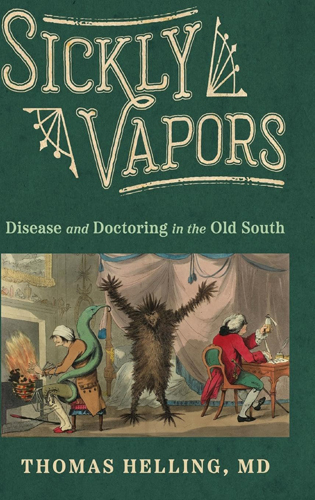
Sickly Vapors: Disease and Doctoring in the Old South
The southern climate, with its heat, oppressive humidity, and stagnant marshland, accentuated disease and suffering for inhabitants of the Old South, from its early settling through the Civil War and Reconstruction. Vicious illnesses—from malaria and yellow fever to dysentery, cholera, typhoid fever, typhus, and smallpox—beleaguered those dwelling in the South and were blamed on the particular combination of air, earth, and water characteristic of those southern territories. As the rhetoric of southern sectionalism blossomed in the early nineteenth century, so did a growing feeling of southern distinctiveness in health issues. Sickly Vapors: Disease and Doctoring in the Old South is an examination of the unique circumstances of health and disease that shaped southern living and culture before, during, and after the Civil War.
Through archival records, contemporary anecdotes, and scientific literature, Thomas Helling, MD, explores the intricacies of health and healthcare for an agrarian population that, by virtue of its location, was inordinately vulnerable to sicknesses and epidemics. With the influx of enslaved Africans, a new set of healthcare issues were introduced. Given the region’s peculiar climate, ethnic makeup, and customs, southern doctors adopted an attitude of distinctiveness themselves. As a result, southern medical progress became increasingly isolated from northern colleagues. The destructiveness of the Civil War finally provided the impetus for true integration with northern practices in the rapidly changing science of medicine and surgery. Yet, with the regeneration of a medical elitism in postbellum years, southern doctors clung to nostalgic notions of southern culture and southern medical distinctiveness. In this compelling volume, Helling explains how the predominant mindset of southern particularity guided regional interpretation of illness, therapeutic decisions, and medical education, foreboding a healthcare system embedded, still, with institutional racism.