

This website has a .gov link

The .gov means it’s official.

Louisiana government websites often end in .gov. Before sharing sensitive information, make sure you’re on a Louisiana government site.

HTTPS Connection

The site is secure.

The https:// ensures that you are connecting to the official website and that any information you provide is encrypted and transmitted securely.

Theresa McCulla is a curator and historian. Currently, she is Curator at Mars, Incorporated. Previously, she was the curator of beer history at the Smithsonian’s National Museum of American History. Her writing has been awarded by the James Beard Foundation and the North American Guild of Beer Writers. Insatiable City: Food and Race in New Orleans was named a Best Book of 2024 by Smithsonian Magazine and nominated for a 2025 James Beard Book Award.


Schedule

1:00 pm to 1:45 pm
Outside Museum, North Tent
Passageways and Foodways: Slavery and Racism in the Formation of Southern Cities
Jennie Lightweis-Goff, Captive City: Meditations on Slavery in the Urban South
Theresa McCulla, Insatiable City: Food and Race in New Orleans
with moderator Eva Semien Baham

2:00 pm to 2:45 pm
Cavalier House Books Tent
Book Signing
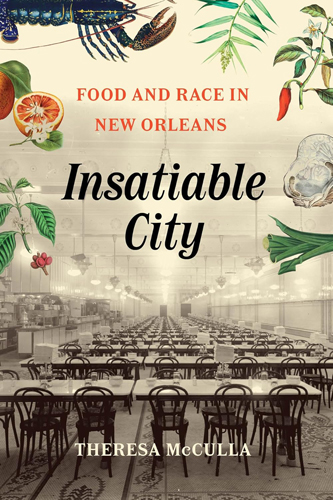

Insatiable City: Food and Race in New Orleans

A 2025 James Beard Foundation Book Award Nominee in Reference, History, and Scholarship and a Smithsonian Best Book of 2024

A history of food in the Crescent City that explores race, power, social status, and labor.
 
In Insatiable City, Theresa McCulla probes the overt and covert ways that the production of food and the discourse about it both created and reinforced many strains of inequality in New Orleans, a city significantly defined by its foodways. Tracking the city’s economy from nineteenth-century chattel slavery to twentieth-century tourism, McCulla uses menus, cookbooks, newspapers, postcards, photography, and other material culture to limn the interplay among the production and reception of food, the inscription and reiteration of racial hierarchies, and the constant diminishment and exploitation of working-class people. The consumption of food and people, she shows, was mutually reinforced and deeply intertwined. Yet she also details how enslaved and free people of color in New Orleans used food and drink to carve paths of mobility, stability, autonomy, freedom, profit, and joy. A story of pain and pleasure, labor and leisure, Insatiable City goes far beyond the task of tracing New Orleans's culinary history to focus on how food suffuses culture and our understandings and constructions of race and power.